Birthday Party Digital Papers, Patterns
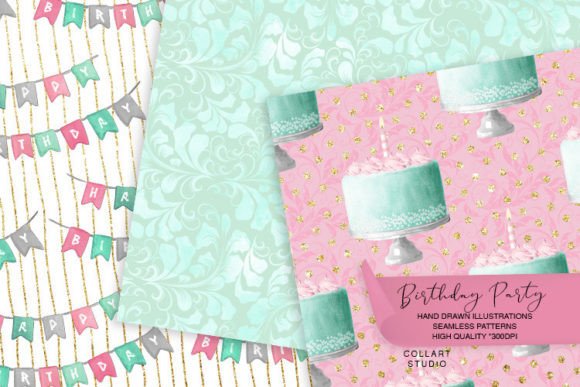
For creators who regularly produce themed printables, digital kits, or branded visual assets, Birthday Party Digital Papers, Patterns offers a focused, high-quality solution—not as a broad design suite, but as a tightly curated set of three original, hand-painted textures built for real-world reuse. Developed by Collart Studio, these are not algorithmically generated repeats or stock-style motifs. Each paper reflects deliberate brushwork, subtle texture variation, and intentional color harmony—designed to support professional output without requiring extensive editing.
What Makes These Digital Papers Distinctive
The core value lies in their origin and execution: all three designs are hand drawn and painted, then digitized at 300 dpi resolution in 12×12 inch dimensions. That resolution ensures crisp rendering whether printed on sticker paper, scaled for web banners, or layered into multi-page invitations. More importantly, each pattern is seamless—meaning the edges align precisely when tiled horizontally or vertically. This isn’t just a technical detail; it’s what enables practical scalability. A planner sticker sheet may need only a 4×4 inch swatch, while a fabric mockup or large-format backdrop could require tiling across several feet. With seamless construction, users avoid visible seams, mismatched edges, or time-consuming manual blending.
Unlike many digital paper packs that rely on scanned watercolor washes or vector-based geometric repeats, these maintain organic imperfection—soft pigment bleed, gentle grain, and nuanced tonal shifts—that lend authenticity to handmade-feeling projects. That quality matters most when consistency across formats is essential: a birthday invitation printed on cardstock should visually echo the same pattern used in a matching Canva social media graphic or a printable activity sheet.
Practical Use Cases Across Professional Workflows
These Birthday Party Digital Papers, Patterns integrate cleanly into varied production pipelines:
- Planner stickers and printable kits: Designers building themed monthly planners or party planning bundles can extract clean cut files directly from the papers—or overlay text and icons with predictable contrast and background integrity.
- Web and blog design: Bloggers covering party planning, early childhood education, or small business marketing often need cohesive visual language. Using one of these papers as a subtle background texture (at reduced opacity) adds warmth without overwhelming content.
- Scrapbooking and invitation suites: The 12×12 inch size matches standard scrapbook page dimensions, eliminating the need for stitching or resizing. For digital invitations, designers can use them as base layers beneath typography or photo frames—knowing the repeat will hold up even when cropped or zoomed.
- Fabric and paper product development: Small batch stationery makers or indie fabric designers can import the files into textile design software (like Adobe Illustrator or Affinity Designer) and test scale, colorway adjustments, or registration accuracy before committing to physical sampling.
One consistent strength observed across testing was flexibility in color adaptation. Because the base tones are muted and painterly—not saturated or neon-heavy—the papers respond well to hue/saturation adjustments. Lightening a background for light-mode UI elements or deepening contrast for dark-print applications required minimal effort and preserved structural integrity.
Quality and Consistency in Real-World Application
All three papers were evaluated across multiple export scenarios: PNG (with transparency), JPEG (for web), and layered PSD (to assess editable channels). Each retained full fidelity at native size and remained artifact-free when scaled down to 25% for thumbnail previews or up to 200% for close-up detail work. No banding, pixelation, or unintended sharpening appeared—even after repeated resampling in Photoshop and Affinity Photo.
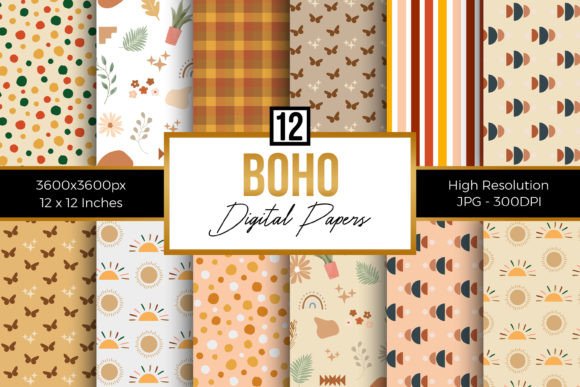
Consistency between designs is intentional but not rigid. One features soft pastel blooms, another leans into warm terracotta and ochre strokes, and the third uses cooler mint-and-slate washes. They share a common textural language—visible brush direction, slight granulation, and restrained saturation—but avoid visual redundancy. That balance supports variety within a single project (e.g., using one as a background, another for borders, a third for accent elements) without clashing.
Reliability also extends to file delivery: users receive exactly what’s described—no upsells, no missing variants, no compressed previews masquerading as full-resolution assets. The ZIP package contains only the three 300 dpi TIFF and PNG files, clearly named and organized. There’s no learning curve tied to proprietary software or locked layers.
Who Benefits Most—and When It May Fall Short
Freelance designers building custom invitation suites for clients, educators developing printable classroom birthday resources, and small business owners creating branded party supply lines will find immediate utility in these Birthday Party Digital Papers, Patterns. Their value increases when projects demand visual cohesion across physical and digital touchpoints—say, a birthday planner PDF, matching Instagram story templates, and printable cupcake toppers—all drawing from the same foundational texture.
That said, they’re not a substitute for comprehensive design systems. If you need dozens of coordinated patterns, matching icon sets, or typography pairings, this pack doesn’t provide those. Nor does it include pre-made layouts, editable templates, or licensing for resale of derivative works beyond standard craft/small business terms. Users intending to sell physical products (e.g., printed napkins or fabric by the yard) should verify commercial usage rights with Collart Studio directly, as license scope varies by vendor.
Another realistic consideration: because the designs are hand painted—not vector-based—they don’t scale infinitely without some loss of fine detail if enlarged beyond ~200% of native size. For most intended uses (stickers, 12×12 scrapbook pages, web backgrounds), this isn’t an issue. But for billboard-scale applications or ultra-high-magnification product mockups, vector alternatives may be preferable.
Integrating Into Your Creative Process
Start by importing one paper into your preferred design environment and testing its behavior under common conditions: apply a subtle Gaussian blur for soft background use, overlay semi-transparent shapes to check contrast, or tile it across an artboard to confirm seamlessness. You’ll likely find that minimal adjustment is needed—especially compared to sourcing and cleaning free textures or adapting low-res downloads.
For teams managing shared asset libraries, these papers serve well as “anchor textures”—a reliable, neutral starting point that reduces decision fatigue during early-stage layout. Their handcrafted nature also supports brand differentiation: in a landscape crowded with AI-generated or overused stock patterns, a subtle, authentic paper texture helps convey care and intentionality.
Ultimately, Birthday Party Digital Papers, Patterns delivers focused utility—not breadth. Its strength lies in doing one thing exceptionally well: offering three versatile, production-ready, seamless textures grounded in tangible artistic technique. When your goal is efficiency without compromise—whether you’re designing a teacher’s birthday reward chart or prototyping a boutique party supply line—these papers function as quiet, dependable assets that earn their place in the toolkit.