Swirling Seamless Tiling Patterns: A Practical Guide for Designers and Makers
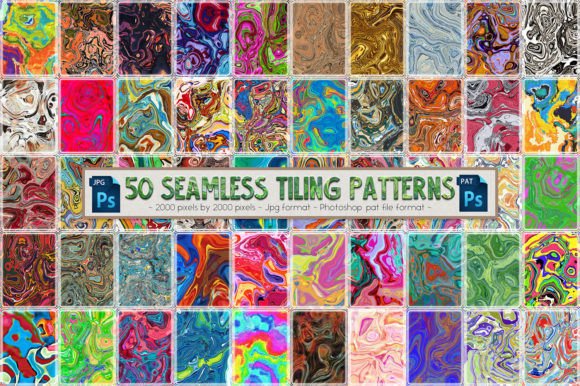
Swirling Seamless Tiling Patterns is a curated collection of 50 distinct, hand-crafted tileable designs—each built around organic, rotational, and fluid visual rhythms. Unlike geometric or rigidly structured repeats, these patterns emphasize motion, soft transitions, and layered complexity, making them especially effective where subtlety and depth matter: digital backgrounds, print textures, surface design, and layered compositing. The set stands out not just for its aesthetic cohesion but for its technical readiness—every pattern arrives as a high-resolution 2000×2000 pixel JPEG, plus a single Photoshop .pat file bundling all 50 for immediate use in Adobe applications.
What Makes Swirling Seamless Tiling Patterns Distinct?
The defining trait is intentionality in flow. Each pattern avoids hard edges or abrupt directional shifts; instead, they rely on gradual curvature, overlapping loops, and balanced negative space to create continuity across seams. This isn’t just “seamless” in the technical sense—it’s seamless in perception. When tiled at scale, the eye doesn’t catch repetition or alignment cues. That makes them more versatile than many algorithmically generated or grid-based tiles, particularly in contexts where visual fatigue or pattern recognition must be minimized—like website headers, textile mockups, or long-scrolling digital interfaces.
Resolution and format also support real-world workflows. At 2000×2000 pixels, each JPEG scales cleanly across common screen sizes and standard print resolutions up to ~12×12 inches at 300 DPI. The inclusion of a unified .pat file means users can load the entire library into Photoshop with one click—no manual registration, no mismatched scaling, no reimporting. That integration saves time, especially when testing multiple options during layout or prototyping.
How It Compares to Other Tile Pattern Options
Not all seamless tiling resources serve the same purpose. Swirling Seamless Tiling Patterns occupies a specific niche between highly structured vector repeats (common in SVG pattern libraries) and broad, generic texture packs (often optimized for photo overlays rather than true tiling). Vector-based alternatives offer infinite scalability and smaller file sizes but tend to prioritize precision over organic variation—making them less suited for backgrounds requiring atmospheric warmth or tactile nuance. In contrast, many free or low-cost JPEG tile sets sacrifice resolution, consistency, or seam quality to maximize quantity, resulting in visible artifacts or inconsistent density across the set.
Compared to procedural generation tools (like those built into Substance Designer or online pattern generators), Swirling Seamless Tiling Patterns trades flexibility for reliability. You can’t tweak parameters on the fly—but you also don’t need to troubleshoot UV mapping, export settings, or color bleed. What you see is what you get, and every pattern has been visually verified for repeat integrity. That predictability matters most when working under deadlines or across collaborative environments where consistency trumps customization.
Strengths and Real-World Fit
Swirling Seamless Tiling Patterns excels in scenarios where human-centered texture and cohesive rhythm are priorities. For digital scrapbookers, the swirl motifs integrate naturally with handwritten fonts, watercolor elements, and vintage-inspired layouts—without competing for attention. For product designers, the patterns translate well to physical surfaces: laser-etched wood, sublimated fabric, or embossed stationery—thanks to their moderate contrast and lack of fine, fragile detail that might break down in production.
Print crafters benefit from the consistent 2000×2000 dimension: it allows easy resizing to standard paper formats (e.g., 8.5×11″ or A4) while preserving enough detail for cutting, folding, or layering without pixelation. And because the JPEGs are RGB and sRGB-encoded, color behavior remains predictable across monitors and consumer-grade printers—unlike some high-bit-depth or CMYK-only assets that require additional calibration.
Where It Fits Best
- Digital background layers—especially for websites, presentations, or social media banners where soft movement supports content without distraction.
- Surface design for small-batch manufacturing—think ceramic decals, notebook covers, or tote bag prints where subtle repetition reads as artisanal rather than mechanical.
- Hybrid analog-digital workflows—scanning printed tiles for collage, using them as underlays in Procreate or Affinity Designer, or tracing motifs by hand.
- Educational or exploratory use—studying how rotation, scale, and density affect perceived seamlessness, or comparing how different swirl densities behave across devices.
Tradeoffs and Limitations to Consider
Swirling Seamless Tiling Patterns isn’t designed for maximal stylistic range. If you need sharp angles, crystalline symmetry, or stark monochrome geometry, this set won’t fulfill that need—and that’s by design. It leans into a particular visual language: rhythmic, gentle, and slightly impressionistic. Users seeking bold, high-contrast, or culturally specific motifs (e.g., traditional paisley, Islamic tessellations, or Art Deco borders) will find the palette and structure too narrow.
The JPEG-only raster format also limits certain advanced uses. You can’t recolor individual elements non-destructively, adjust stroke weight, or isolate components for editing—tasks better handled by layered PSD files or vector sources. Similarly, while the .pat file works in Photoshop and compatible hosts, it won’t function in Affinity Photo, Figma, or web-native CSS background declarations without conversion.
There’s also no licensing documentation included with the download. While personal and commercial use is typical for such asset bundles, users intending to redistribute, resell, or embed the patterns into SaaS templates should verify usage rights directly with the source—especially if operating in regulated industries or large-scale publishing contexts.
When to Choose Swirling Seamless Tiling Patterns—And When to Look Elsewhere
This set is a strong match if your workflow values speed, visual harmony, and cross-medium adaptability—and if your projects center on warmth, movement, or quiet sophistication. It’s especially helpful when evaluating alternatives to stock photo backgrounds or default software patterns that feel impersonal or overly repetitive.
Conversely, consider other resources if your work demands:
- Full vector control—for branding systems requiring exact color matching, responsive scaling, or multi-format output (SVG, EPS, PDF).
- Thematic specificity—such as botanical, architectural, or cultural motifs with strict iconographic requirements.
- Dynamic generation—where variables like color palette, density, or orientation must shift per project or user input.
- Accessibility-first design—since none of the patterns include contrast or motion-sensitivity testing data, they may require manual evaluation for WCAG compliance in public-facing interfaces.
For example, a greeting card designer building a seasonal collection might choose Swirling Seamless Tiling Patterns for its cohesive, hand-drawn feel—then supplement with a single custom vector border for envelope liners. A UI designer prototyping a wellness app could test several swirl patterns as subtle scroll-layer textures before finalizing one that balances calmness with enough visual interest to prevent flatness on light mode.
Making an Informed Choice
Swirling Seamless Tiling Patterns offers clarity through constraint: 50 thoughtfully made options, technically sound and aesthetically aligned. That focus reduces decision fatigue without sacrificing quality. It doesn’t replace broader asset libraries—but it fills a gap many designers encounter: the need for seamless patterns that feel intentional, not incidental.
Before committing, ask yourself: Do I need variety across styles—or consistency within one? Will these be used primarily as base layers or as foreground elements? Does my output pipeline favor raster reliability or vector flexibility? Answering those questions honestly helps determine whether Swirling Seamless Tiling Patterns aligns with your current needs—or whether pairing it with another resource yields better long-term utility.