Forest Animals Seamless Patterns: A Versatile Resource for Creative Professionals and Educators
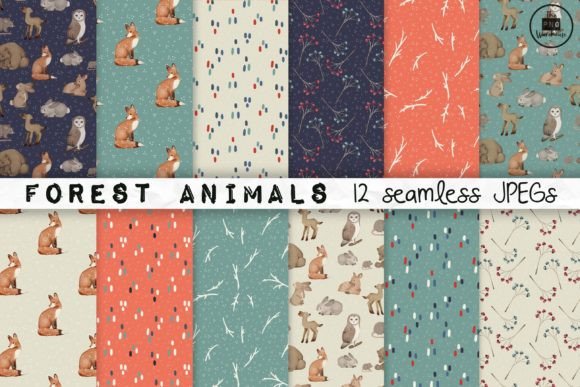
Seamless pattern design bridges artistry and utility—especially when rooted in nature’s quiet elegance. The Forest Animals Seamless Patterns digital paper pack exemplifies this balance: a curated set of 12 hand-painted backgrounds featuring foxes, owls, deer, hedgehogs, rabbits, and other woodland creatures, rendered with organic texture and thoughtful color harmony. Unlike algorithmically generated repeats, these patterns carry the subtle irregularities of real brushwork—soft watercolor edges, gentle pigment pooling, and nuanced layering—that lend authenticity to both print and digital applications. Their seamless construction means they tile infinitely without visible seams, making them functionally robust across scales and surfaces.
Why Hand-Painted Seamless Patterns Matter in Practice
Not all seamless patterns are created equal. Many rely on digital cloning or vector repetition, which can produce sterile, mechanical results—especially at large sizes or high resolutions. In contrast, the Forest Animals Seamless Patterns were painted by hand first, then digitally refined to preserve grain, warmth, and variation. This approach ensures visual richness even when zoomed in or printed at full 3600-pixel width (12×12 inches at 300 DPI). For educators designing classroom posters, illustrators building textured storybook covers, or textile designers developing eco-conscious fabric lines, that fidelity translates directly into perceived quality and emotional resonance.
Consider a university biology department creating illustrated field guides: using a hand-painted owl motif as a subtle background for species profiles adds thematic cohesion without competing with scientific diagrams. Or imagine a small-batch stationery brand launching a nature journal line—the deer-and-fern repeat in navy offers sophistication and legibility for handwritten notes, while the beige fox pattern provides warmth and approachability for greeting cards. These aren’t decorative afterthoughts; they’re intentional scaffolds for communication.
Color Strategy: Beige, Teal, Navy, and Red—Purposeful Palettes
The pack’s four core colorways weren’t selected arbitrarily. Each serves distinct functional and psychological roles:
- Beige: A neutral, earthy base that evokes unbleached linen or parchment. Ideal for educational materials where readability is paramount—text overlays remain crisp, and the tone supports calm focus in learning environments.
- Teal: A balanced blend of blue’s stability and green’s growth. Frequently used in wellness branding and environmental nonprofits, teal conveys trust and natural harmony—making it especially effective for conservation-themed reports or children’s nature activity books.
- Navy: Deep, authoritative, and versatile. Works equally well for academic publishing (think university press book covers) and premium product packaging. Its richness holds up under foil stamping or spot UV finishes.
- Red: Not primary-school bright, but a muted, terracotta-tinged red—evoking autumn berries and forest floor decay. Adds warmth and visual weight without overwhelming, perfect for seasonal marketing campaigns or handmade craft labels.
This restrained palette avoids trend-driven saturation, prioritizing longevity and cross-context compatibility. Designers report reusing these colors across client projects spanning education, publishing, retail, and interior decor—proof that intentionality in color selection expands reuse potential far beyond initial scope.
Educational Tools and Learning Environments
In classrooms and homeschool settings, patterned backgrounds do more than decorate—they support cognitive processing. Research in educational psychology suggests that low-contrast, nature-based visuals reduce cognitive load while reinforcing thematic content. A teacher printing a set of forest animal flashcards on the owl-in-teal pattern creates implicit associations between form and function: the image isn’t isolated—it lives within its ecological context. Similarly, laminated behavior charts using the deer-in-navy repeat provide consistent visual cues without visual fatigue.
Small Business Branding and Product Development
For makers and micro-businesses, consistency across touchpoints builds recognition faster than logos alone. One ceramicist uses the fox-in-beige pattern as her website background, business card liner, and packaging wrap—creating a unified sensory experience from screen to shelf. Another uses the red hedgehog repeat to line custom gift boxes for a foraged botanical tea line, reinforcing origin and craftsmanship. Because all files are JPEGs at 300 DPI, there’s no compromise when scaling from social media banners to trade show backdrops.
Digital and Print Publishing
Authors and indie publishers benefit from seamless flexibility. A children’s book illustrator might use the owl pattern as a textured overlay behind chapter title pages, adjusting opacity to let typography dominate while retaining atmosphere. A researcher compiling an open-access ecology anthology could apply the navy deer motif to section dividers—subtly signaling transitions without distracting from dense textual content. Since each file is 3600 pixels square, cropping for eBook cover thumbnails (e.g., 2560×1600) or print-ready hardcover jackets (e.g., 6×9 inches with bleed) requires no resampling or quality loss.
Technical Considerations for Seamless Integration
While “seamless” sounds straightforward, implementation depends on software fluency and output intent. Here’s what practitioners should know:
- File format limitations: JPEGs are universally compatible but lack transparency. If layering over photos or gradients, users may need to convert to PNG first—or use blending modes (e.g., Multiply in Photoshop) to preserve depth.
- Scale awareness: At 12×12 inches / 3600 pixels, these patterns excel for large-format prints—but for web use, consider exporting optimized versions (e.g., 1200×1200 pixels at 72 DPI) to maintain performance without sacrificing clarity on retina displays.
- Tiling behavior: Though seamless, some patterns have stronger directional flow (e.g., the rabbit-and-mushroom repeat moves horizontally). Test tiling in your target layout tool—Figma, InDesign, or Canva—to confirm alignment before finalizing multi-page documents.
- Color management: The provided RGB values are calibrated for screen accuracy. For commercial printing, request a CMYK conversion from your printer or use soft-proofing tools to avoid unexpected shifts—especially in the teal and red variants.
These aren’t obstacles—they’re checkpoints. Understanding them transforms the Forest Animals Seamless Patterns from passive assets into active components of a disciplined workflow.
User-Centered Workflow Integration
How creators actually use these patterns varies widely—and that’s by design. A graphic designer working on a corporate sustainability report might start with the navy deer background, then isolate individual animals using clipping masks to create custom icons. A journaling enthusiast may import the beige fox pattern into GoodNotes, set it as a page template, and write reflections directly over its gentle rhythm. A textile student could import the teal owl repeat into Spoonflower’s design tool, adjust scale for quilting cotton, and order a test swatch before committing to yardage.
What unites these approaches is adaptability without abstraction. Because the source artwork is hand-painted—not procedurally generated—each animal retains expressive nuance: an owl’s asymmetrical feathering, a fox’s whisker-like stroke detail, a deer’s softly blurred antler edge. That humanity invites reinterpretation rather than rigid adherence. It’s why educators use them as starting points for student-led pattern remixing exercises, and why researchers incorporate them into qualitative data visualization decks—not as decoration, but as contextual framing.
Sustainability and Ethical Design Alignment
Beyond aesthetics, this pack aligns with growing professional expectations around responsible creation. All 12 patterns are digital-first—no physical sampling, no ink waste, no shipping emissions. Their reusable nature reduces the need for repeated asset commissioning. More subtly, their subject matter reinforces biophilic design principles: integrating natural imagery improves user engagement and emotional response across platforms. Hospitals use similar motifs in pediatric waiting areas; libraries embed them in literacy program materials; urban planners reference such palettes in green infrastructure proposals.
That resonance isn’t incidental. Forest ecosystems represent complexity, interdependence, and quiet resilience—qualities increasingly valued in design thinking. Choosing a fox-in-beige pattern over a generic geometric repeat signals attention to narrative, ecology, and human-centered meaning. It’s a small choice with layered implications.
Expanding Beyond the Obvious
While fabric, cards, and journals are expected applications, practitioners continue discovering novel uses. One architecture firm uses the red hedgehog pattern as a subtle grid overlay in site analysis maps—its organic rhythm disrupts the rigidity of CAD linework without obscuring data. A music therapist prints the owl-in-teal repeat on sound-dampening wall panels for sensory rooms, where the soft repetition supports regulation without overstimulation. A university library digitizes the navy deer background as part of its archival metadata interface—providing visual continuity across centuries of scanned manuscripts.
These examples underscore a key truth: the value of the Forest Animals Seamless Patterns lies not in prescribed usage, but in permission—to adapt, reinterpret, and integrate according to domain-specific needs. They are infrastructure, not ornament.