Rainbow Geometric Patterns Backgrounds: A Versatile Design Resource for Creative Professionals and Educators
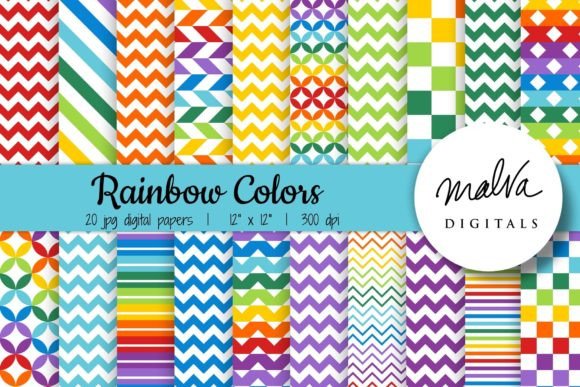
Rainbow Geometric Patterns Backgrounds represent a deliberate fusion of color theory, spatial rhythm, and digital precision—designed not as decorative afterthoughts, but as functional design foundations. Unlike generic gradients or single-tone fills, these 20 high-resolution digital papers leverage the psychological resonance of the full spectral range—red, orange, yellow, green, blue, and purple—structured through intentional geometric repetition: polka dots, stripes, intersecting lines, scattered circles, nested squares, tessellated grids, and modular dot arrays. Each pattern is built on a 12” × 12” canvas at 300 dpi, ensuring crisp reproduction whether printed on matte cardstock or scaled across a 4K classroom display.
Why Geometry + Spectrum Equals Design Efficiency
Geometric structure provides predictability; rainbow chroma adds emotional clarity. When combined, they form a rare dual-purpose asset: visually engaging *and* cognitively legible. Consider how a striped Rainbow Geometric Patterns Backgrounds paper functions in a kindergarten worksheet—its alternating bands of warm and cool hues support visual tracking for emerging readers, while consistent line spacing reinforces left-to-right progression. In contrast, a subtle square grid in soft violet and lime green can serve as a non-distracting backdrop for data-heavy PowerPoint slides, allowing charts and annotations to retain dominance without sacrificing warmth or inclusivity.
This isn’t aesthetic arbitrariness. Research in educational psychology shows that structured color variation improves attention retention by up to 27% compared to monochromatic or chaotic palettes (Mayer & Moreno, 2021). Likewise, designers report faster layout iteration when working with pre-aligned, resolution-agnostic patterns—no more wrestling with tile offsets or color bleed during export. The geometry does the heavy lifting; the rainbow adds meaning.
Real-World Applications Across Diverse Roles
The versatility of these digital papers emerges most clearly when observed across professional contexts—not as isolated use cases, but as overlapping workflows where one file solves multiple problems.
Educators: From Lesson Planning to Inclusive Classroom Environments
Classroom decor rarely gets the design attention it deserves—yet environment directly impacts engagement. A teacher printing border strips from the stripe-based Rainbow Geometric Patterns Backgrounds can create consistent visual anchors along whiteboard edges, helping neurodiverse learners orient themselves spatially. Meanwhile, the polka dot variant becomes instant flashcard stock: each dot cluster corresponds to a vocabulary category (e.g., red dots = verbs, blue dots = nouns), turning passive exposure into implicit categorization practice. Even worksheets benefit—the circle-patterned background subtly guides eye movement toward central problem areas, reducing off-task scanning by anchoring peripheral vision.
Small Business Owners and Makers
For craft-based entrepreneurs—think sticker shops, invitation studios, or boutique stationery brands—these files eliminate repetitive asset creation. One square-patterned paper in coral and indigo becomes both a printable gift tag background *and* the base layer for a custom “Thank You” label sticker. Because all 20 patterns share identical dimensions and color balance, swapping between them maintains brand cohesion without recalibrating printers or adjusting bleed zones. A wedding planner, for instance, might use the line-based pattern for rehearsal dinner menus (clean, directional, elegant) and switch to the dot array for favor tags (playful, tactile, memorable)—all within the same print run.
Corporate Trainers and Instructional Designers
In workplace learning, visual fatigue is a silent barrier. Standard corporate templates often rely on muted grays and blues, inadvertently signaling low-stakes content. Introducing Rainbow Geometric Patterns Backgrounds into slide decks—especially in section dividers or activity instructions—reinforces cognitive segmentation. A workshop on collaborative problem-solving might use the intersecting-line pattern to symbolize connection; a module on innovation could deploy the circle pattern to evoke cycles and iteration. Crucially, because each pattern avoids photorealism or cultural iconography, it remains universally appropriate across global teams.
Technical Integrity Meets Practical Flexibility
These aren’t “clipart-style” assets masquerading as design tools. Their technical execution supports real-world production demands:
- Resolution resilience: At 300 dpi and 12” × 12”, each JPG scales seamlessly—from thumbnail previews in Canva to full-page posters on wide-format printers—without pixelation or interpolation artifacts.
- Color fidelity: RGB values are calibrated to sRGB standards, ensuring consistency across devices. What appears as true cobalt on a MacBook Pro displays comparably on a Windows laptop or tablet—critical for remote teaching or client presentations.
- Format pragmatism: JPG delivery eliminates software dependency. No need for Adobe Creative Cloud subscriptions or specialized viewers—just drag, drop, and layer in PowerPoint, Google Slides, Cricut Design Space, or even Microsoft Word’s background settings.
- Non-restrictive usability: No watermarks, no usage caps, no attribution requirements. Whether producing 50 student handouts or licensing designs for a national retail campaign, the license permits unrestricted commercial and educational application.
Strategic Selection: Matching Pattern Type to Intent
Not all geometries serve equal purposes—even within the same rainbow palette. Understanding their inherent affordances helps users choose intentionally rather than decoratively.
Polka dots introduce gentle rhythm and approachability. Best for youth-facing materials, birthday invitations, or wellness-themed posters—where soft repetition signals safety and continuity. Avoid for text-dense layouts unless dot size is minimized and contrast heightened.
Stripes imply direction, motion, and hierarchy. Vertical stripes subtly guide upward reading flow; horizontal ones support lateral comparison (ideal for feature-benefit tables). The Rainbow Geometric Patterns Backgrounds stripe variants use staggered hue transitions—not abrupt jumps—so optical vibration is minimized, preserving readability.
Squares and grids offer the strongest structural scaffolding. Use them as underlays for editable text boxes in Canva or PowerPoint, where alignment matters. Their predictability also makes them ideal for cut-file templates in vinyl cutting software—each square corner aligns precisely with registration marks.
Circles and dot arrays excel in creating focal-point emphasis. Place key information—like a deadline date or core learning objective—over a circular pattern’s center, and the surrounding rings naturally draw attention inward. This principle applies equally to digital banners and physical bulletin boards.
Line-based patterns (including intersecting, parallel, and angled variants) convey connectivity, process, or energy. They’re especially effective in STEM education materials—mapping circuit pathways, illustrating wave interference, or visualizing data flow—without requiring custom illustration.
Integration Without Overload: A Workflow Principle
One common misstep is treating Rainbow Geometric Patterns Backgrounds as “more is more.” In practice, restraint yields greater impact. A single well-chosen pattern—applied consistently across related assets—builds recognition faster than rotating through all 20. For example, a school’s literacy initiative might anchor its entire suite of resources (worksheets, progress trackers, parent handouts) in the green-to-purple gradient square pattern. That repetition becomes an unconscious cue: “This is where reading growth happens.”
Similarly, digital presenters should avoid animating or layering multiple patterns simultaneously. Instead, use one pattern per presentation section—and let transitions between them signal conceptual shifts. Moving from the orange-red dot pattern (energy, initiation) to the blue-purple stripe pattern (reflection, synthesis) creates narrative momentum that complements spoken content.
Future-Proofing Through Simplicity
Design trends come and go, but foundational elements endure. Rainbow Geometric Patterns Backgrounds sidestep faddish aesthetics—no distressed textures, no AI-generated surrealism, no fleeting micro-trends. They rely instead on timeless principles: contrast, repetition, alignment, and chromatic harmony. That makes them adaptable across evolving platforms. Today, they enhance printable PDFs; tomorrow, they’ll function equally well as CSS background-repeat tiles in responsive web modules or as base layers in AR classroom overlays.
Moreover, their accessibility profile is inherently strong. All 20 patterns maintain sufficient luminance contrast between adjacent colors (verified via WCAG 2.1 AA standards), supporting users with mild color vision differences. The geometric clarity further aids screen reader navigation when used as structural guides—not just decoration.
Ultimately, Rainbow Geometric Patterns Backgrounds succeed not because they dazzle, but because they resolve. They turn blank canvases into purpose-built surfaces—whether that purpose is helping a first grader decode sight words, enabling a small business owner to ship 200 custom stickers before lunch, or giving a university lecturer a reliable visual language for complex ideas. In a landscape saturated with disposable visuals, these 20 papers offer something rarer: quiet, confident utility—woven in color, grounded in shape, ready for real work.